Somewhere in your organisation right now, there is data about how your people are developing.
LMS completion rates. Assessment scores. Coaching session outcomes. Virtual classroom attendance. Immersive simulation performance. It exists. It's being generated continuously. And for most organisations, it's almost entirely invisible to the people who need it most.
L&D leaders spend hours each month pulling reports from different systems, reconciling conflicting formats, and producing documents that feel accurate by the time they leave the desk but are already outdated by the time they reach a manager. Boards receive broad summaries, completion percentages, maybe, that tell them very little about whether their workforce is actually ready for what the business needs from them.
According to AIHR, only 29% of L&D leaders feel confident proving learning ROI to their organisation. According to 360Learning, only 13% of companies currently evaluate the ROI of their L&D programmes in any meaningful way.
That gap is exactly what FabricAcademy's Analytics and Reporting capability was built to close.
The Problem with Disconnected Systems
The challenge isn't that the data doesn't exist. It's that it exists in too many places, in too many formats, with no unified view.
Most enterprise organisations run learning across multiple platforms, an LMS for formal programmes, a separate system for virtual classrooms, perhaps a third tool for compliance tracking, and increasingly a range of additional technologies for immersive, AI-powered, and experiential learning. Each produces its own data. Each speaks its own language. None of them talk to each other.
The result is that your L&D team spends disproportionate time on data archaeology, finding the information, translating it, and assembling it into a coherent picture, rather than on the strategic work of improving programmes and developing people.
And even when they do assemble the picture, it answers the wrong question. It tells you what happened. It doesn't tell you why, or what to do about it.
One View, Updated in Real Time
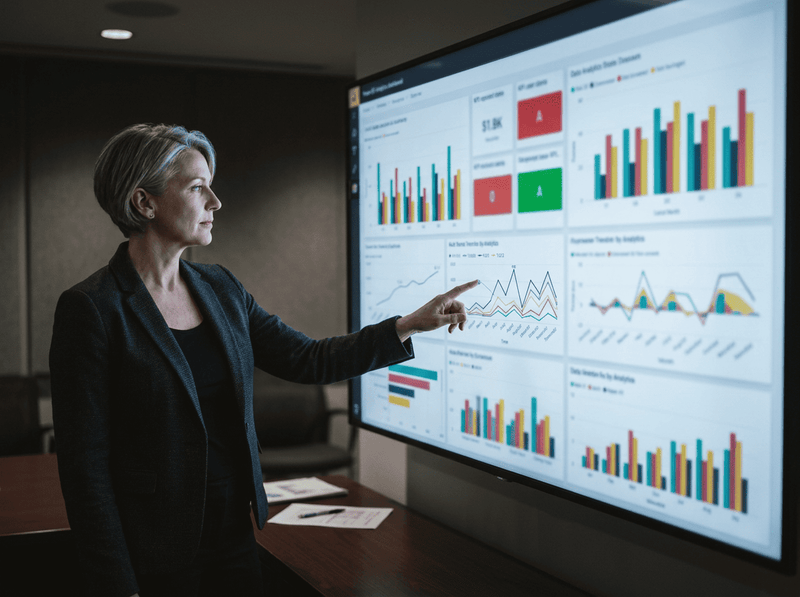
FabricAcademy's analytics layer draws data from every capability within the ecosystem, LMS completions, immersive training scores, AI coaching progression, virtual classroom attendance, blended learning pathway data, and presents it in role-appropriate dashboards designed for decision-making.
Learner dashboards show individual progress, upcoming requirements, and development recommendations. Manager dashboards show team capability, compliance status, and coaching trends. Compliance dashboards give real-time regulatory coverage by role, site, and individual, audit-ready at all times, without manual compilation. Executive dashboards show workforce readiness trends, ROI indicators, and strategic capability metrics that connect learning activity to business performance.
The dashboards are configured to your KPIs, not a standard template. Because what matters most to a global logistics operation is different from what matters most to a financial services firm or a healthcare provider. We build around your strategic priorities, not a generic default.
Learning Connected to Business Performance
The most powerful shift that connected analytics enables is the ability to link learning activity to business outcomes.
Not just 'this team completed their compliance training', but 'this team's incident rate has decreased since the safety programme launched', or 'time to competency for new starters in this role has reduced by six weeks', or 'the teams with highest coaching engagement are showing the strongest performance improvements in this operational metric'.
When learning data connects to your HR and operational systems, those conversations become possible. The analytics layer can integrate with your existing business intelligence environment where data sharing agreements are in place, allowing learning activity to be correlated with the workforce performance metrics you're already tracking.
That's the foundation of a genuine conversation about learning ROI, not a completion rate, but a business outcome.
A Managed Service, Not a Software Product
One thing that makes FabricAcademy's analytics capability genuinely different is the managed service layer that surrounds it.
Analytics platforms create value only when they're properly maintained, kept current, and actively used to inform decisions. A dashboard that nobody reads, or data that hasn't been updated because nobody had time to manage the pipeline, isn't an analytics capability, it's an expensive piece of infrastructure.
FabricAcademy provides a single account team and a single SLA covering everything: platform configuration, data pipeline management, content ingestion, user administration, and quarterly performance reviews. You don't need your own Power BI licence or analytics engineering resource. You don't need to manage the infrastructure independently.
The scope of managed service is agreed at contract stage and can scale from core platform support to full operational management, covering everything from routine data updates to producing executive-ready reports on workforce capability.
FabricAcademy estimates a 40–60% reduction in operational overhead for organisations that move from fragmented reporting to a single managed service partner.
No Existing Infrastructure Required
One of the most common concerns we hear is that analytics feels too big to start, that meaningful reporting requires systems and infrastructure that the organisation doesn't yet have.
It doesn't. We've delivered analytics programmes for organisations starting from manual spreadsheet reporting. The FabricAcademy analytics layer is built from scratch as part of the implementation, starting with the data sources you have available and expanding as the ecosystem grows.
The absence of existing infrastructure is not a barrier. It's just the starting point.
From Data to Decision
Your learning programmes are already producing data. The question is whether that data is reaching the people who need it, in a form they can act on, when it's still relevant.
When it does, when learning activity connects to compliance status, to business performance, to workforce readiness, the conversation about what training is worth changes completely. It stops being a budget line and starts being a strategic lever.
Let's explore what that looks like for your organisation.
Book a strategy session with FabricAcademy and let's build an analytics capability that genuinely supports the decisions your organisation needs to make.